

In This Handbook
Generative AI System Design
Early on, it was easy to believe a large language model’s intelligence was sufficient. However, real-world use quickly proved that consistency, safety, and accountability are essential, not optional. Fundamentally, an LLM only generates text based on learned patterns. It lacks awareness of its information source, memory of past talks, judgment on when to act, or ability to verify its output’s correctness, safety, or suitability. These critical responsibilities are beyond the model’s design, regardless of its apparent sophistication.
A language model alone, even a strong one, cannot function as a complete system. Like an engine needs a car’s steering, brakes, and control systems to harness its power safely and usefully, a model’s raw generative capability requires surrounding structure to reliably produce value in real-world settings.
This observation is not a criticism of models, but a clarification of their role. Previously, we established that models are not systems. We explored mechanisms such as retrieval and memory that compensate for model limitations. This chapter completes that progression by showing how those pieces are assembled into end-to-end systems, where responsibility and control live outside the model itself.
ⓘ Models vs. systems
Generative models are designed to produce outputs given an input context. Generative AI systems, by contrast, include additional components that determine when the model is invoked, what information it sees, how its outputs are evaluated, and what actions follow. This separation is what allows generative AI to function reliably in production environments.

Core components of a GenAI system
A typical generative AI system is composed of multiple pieces working together. Key components often include:
- The model (LLM or other generator): This “brains” component receives a prompt and generates content (text, image, etc.). It offers fundamental language understanding and generation capabilities.
- Knowledge retrieval (Context database): Many systems enhance models with current or proprietary data. For instance, Retrieval-Augmented Generation (RAG) uses a vector database of documents. When a user queries the system, the question is vectorized, relevant documents are retrieved, and these snippets, along with the question, are fed to the LLM. This provides the model with “timely contextual information” it didn’t train on, ensuring access to fresh, factual data.
- Memory / state: To maintain conversational continuity or personalization, a system stores state (e.g., chat history, preferences) externally. This state is loaded and included in the prompt before each LLM call. Without this external memory, an LLM is stateless, treating each query in isolation. Most “chatbots with memory” achieve continuity by storing and re-sending chat history or summaries to the otherwise stateless model.
- Orchestration / logic: Orchestration is the logic that decides what to do and when in an AI pipeline, dictating the order of operations (e.g., data fetching, retrieval, LLM call, parsing). It ensures components work sequentially and includes error handling (retry logic, fallbacks) to prevent pipeline failure.
- User interface / API: The front-end is the user interaction layer (chat window, web form, voice assistant, etc.). This interface formats user input for the system and displays the AI’s response. A good interface ensures accessibility and guides user interaction.

If any one component is missing or fails, the system’s behavior changes drastically. For example, no retrieval means the model might hallucinate or rely on stale knowledge; no memory means the system can’t recall earlier conversation or user preferences; poor orchestration might lead to tasks hanging or repeating steps; no proper interface means users can’t even submit queries or understand responses. Each part is critical for the system’s overall capabilities and reliability
ⓘ Responsibility boundaries
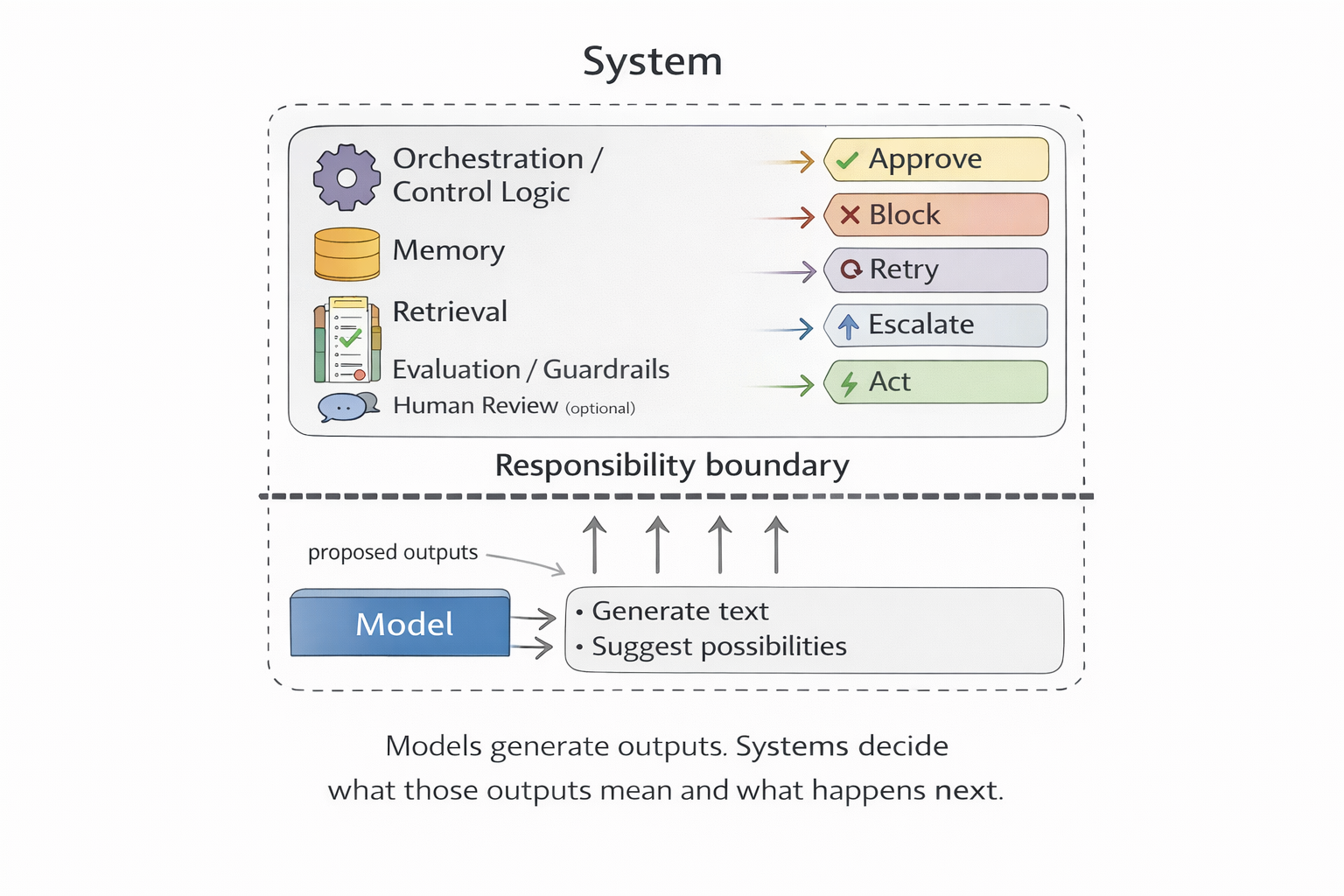
In a well-designed generative AI system, the model is responsible only for generation. Decisions about retrieval, memory, evaluation, and action are handled externally by system components. This separation prevents the model from implicitly becoming a decision-maker.
Evaluation and feedback
A complete generative AI system requires external evaluation to assess its behavior over time; whether outputs are acceptable, useful, or harmful. In production, systems must confirm they are behaving as intended.
Without evaluation, a system cannot distinguish success from failure and remains unaware of its real-world impact. Feedback mechanisms (automated checks, human review, monitoring) enable systems to detect errors or degradation.
Evaluation ensures responsibility, allowing systems to learn if their design is effective and if corrective action is needed.
ⓘ Evaluation as a system function
Models generate outputs but do not judge their quality or impact. Evaluation mechanisms live outside the model and provide the signals needed to assess performance, safety, and reliability over time.
Stateless models vs. stateful systems
A persistent misconception about language models is that they “remember” past interactions. In reality, large language models are stateless by default. Each invocation is independent, and the model has no awareness of previous interactions unless that information is explicitly provided again as input.
When a chatbot appears to remember a conversation, what is actually happening is that the system stores prior messages and re-injects them into the prompt on each turn. The model is not recalling information in a human sense; it is responding to context that has been supplied anew by the system.
State is external to the model and resides in the system. The system manages this state by storing, retrieving, and determining the currently relevant information. This distinction is crucial for design.
A stateless model is neutral, but a stateful system can accumulate risk if poorly designed. Decisions about what to retain, summarize, or discard directly affect continuity, personalization, and safety.

ⓘ Memory as an architectural choice
What appears as “memory” in generative AI applications is the result of system-level storage and retrieval. Models consume context; systems decide what context persists.
Systems outlive interactions
A generative AI system does not exist for a single user or a single interaction. It operates across time, serving many users, accumulating state, and evolving as policies, data, and assumptions change. Design decisions made early may persist long after they are valid, shaping system behavior in subtle ways.
Understanding a system therefore requires looking beyond individual interactions. It must be evaluated in terms of how it changes over time, how state accumulates, and how updates are managed across deployments. This temporal dimension is an essential part of the system boundary and cannot be ignored in production environments.
Data Flow vs. control flow
When generative AI systems fail, the root cause is often confusion between data flow and control flow. Data flow describes what information moves through the system, while control flow describes who decides what happens next. In many early systems, these concerns were conflated.
Designers implicitly treated model output not only as content, but also as a decision signal. If the model produced a response, the system assumed it should be acted upon. This approach is risky because models are optimized to generate plausible text, not to make decisions or assess consequences.
After producing an answer, the system must still decide whether to deliver it immediately, retrieve additional information, ask for clarification, or escalate to a human. These are control decisions, and they should be governed explicitly by system logic rather than inferred from generated text. Robust systems keep control flow outside the model, allowing the model to suggest possibilities while the system determines which path to take.

Humans are inside the system
In many real-world deployments, humans are not external observers but active components of the system. Human judgment may be required when uncertainty is high, when consequences are significant, or when automated processes fail. In these situations, the system has not broken down; it is operating as designed.
Treating human involvement as an afterthought leads to fragile systems that rely on ad-hoc intervention. Treating it as an explicit part of control flow leads to more resilient and accountable designs, where escalation paths and oversight are intentional rather than reactive.
Failure is a system property
When something goes wrong, it is tempting to blame the model. The model hallucinated, misunderstood, or behaved unpredictably. In practice, failures almost always originate in system design rather than model capability. Even strong models can produce incorrect outputs.
The relevant question is whether the system allows those errors to propagate. Robust systems expect errors and are designed to contain them through verification, fallback paths, or confirmation steps. Brittle systems allow unchecked outputs to cascade into downstream failures.
Reliability, safety, and correctness are therefore system-level properties. They cannot be achieved through prompting alone; they must be engineered.

Variability Is not a bug
Generative models do not produce identical outputs every time. The same input can yield different results across invocations because generation is probabilistic by design. This variability is not a flaw, but a fundamental property of generative systems.
What matters is whether the system is designed with this reality in mind. Systems that assume consistent behavior from probabilistic models become fragile, while systems that expect variation can absorb it. Managing non-determinism is therefore an architectural concern rather than a prompting technique.
Context is a budget, not a free resource
Another important system-level constraint arises from the physics of modern models: context is finite and expensive. Every token added to a prompt increases computational cost and latency while competing for attention within a fixed context window. Long prompts do not simply cost more; they dilute focus.
Production systems must therefore treat context as a shared budget among system instructions, conversation history, retrieved knowledge, tool outputs, the user’s current input, and space for the model’s response. When this budget is mismanaged, systems exhibit subtle failures such as ignoring retrieved facts or forgetting critical instructions.

Where responsibility lives
At its core, the boundary between model and system is straightforward. The model generates outputs, but the system decides what those outputs mean, whether they matter, and what happens next. A model may suggest possibilities, but only the system can take responsibility for outcomes.
ⓘ Core principle
Models generate outputs; systems own decisions and consequences.
This lesson completes a conceptual transition that began in Chapter 1. We started by understanding what models can and cannot do, then explored how retrieval and memory extend their usefulness. Here, we have seen how systems bind these components together.
From this point forward, the central question is no longer what the model can do, but what responsibility the system assumes. In the next lessons, we will examine common system forms, such as chat, and then explore orchestration and control in greater depth. Only after that foundation is in place does it make sense to discuss tools and frameworks.
Understanding, not tools, is what creates good systems.

I’m Fahim, a software engineer specializing in generative AI, system design, and responsible AI adoption.